Showing posts with label science. Show all posts

Wednesday, February 13, 2008

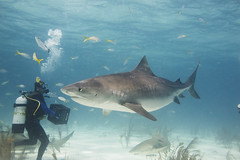
Good News for Shark Fans


Moishe, this means you. From Popular Science.

George Burgess, the director of the International Shark Attack File at the University of Florida, announced today that fatal attacks from the toothy predators dropped to a two-decade low worldwide. Only a single swimmer was lost in 2007, compared to four each in the two years before. Granted, that doesn’t mean sharks are leaving us alone completely. The number of attacks actually increased from 2006 to 2007, jumping from 63 to 71. More than half of these occurred in US or Hawaiian waters.

As for why the number of fatal strike dropped, Burgess suspects this is the result of improved medical treatments and better swimmer awareness.

Thursday, January 31, 2008

Productive Autism? It's a Brave New World, People...


Need to finish that work project, and wish you had the mental intensity to do it? Just take a synapse-regulating inhibitor, induce temporary autism, and you'll want to ignore your friends and do nothing but number-crunching for days. Autism-inducers could become as popular as Provigil among the geek set by 2020. Last night, in fact, a group German researchers announced they'd perfected the method for inducing autism. (They can also cure it.)

Over the past year, researchers have demonstrated several times that they can turn mice autistic by messing with brain chemistry -- and then "cure" them using the same techniques. The discoveries could lead to a scenario similar to the one in Vernor Vinge's novel A Deepness in the Sky, where people are given a brain treatment called "focusing" that essentially turns them autistic and makes them obsessive, detail-oriented workers.

It might also lead to recreational autism, where people who want to take a break from having messy emotions about other people decide to unplug and enter a state where human relationships are no more important than inanimate objects.

Read about how scientists can induce autism [PNAS] and how they can cure it [BBC News].

Monday, January 7, 2008

Forget About Mars, Bitches

Funding Bill Could Limit Exploration Of Mars, Moon


Members of the Mars Society suggest the government's plans are underfunded and could make it difficult to send people to the Red Planet or the moon.


The federal government has not given NASA enough support to advance its exploration of the moon and plans to send people to Mars, according to a group that backs exploration of Mars.

The Mars Society said that the congressional omnibus appropriations bills, signed by President Bush last week, would prohibit research, development, or demonstration activities exclusive to Mars exploration.

The criticism is notable because Bush backs NASA's plans for exploration of the Red Planet as well as the moon.

The bill does increase funding for science missions, including Mars exploration, but the restrictive language limits possibilities, according to the Mars Society.

"Not only is this language counterproductive to running a coherent multiyear exploration plan, but it is not consistent with the NASA authorization that Congress overwhelmingly approved in 2005," the Mars Society explained in an announcement criticizing the bill. "In that authorization bill, Congress approved NASA's plans to send humans to Mars and supported the expenditures that will be necessary to make that goal possible -- something that the omnibus bill does not do."

Mars Society political director Chris Carberry conceded that the bill isn't likely to have a major impact on the program this year but added that the language sets a "terrible precedent."

"If this language makes it into future budgets, I guarantee that this program will slowly become a moon-only effort -- or worse," he said. "Congress and the next president of the United States need to accelerate this program rather than limiting it. We certainly will not be creating an effective program or be serving the taxpayers well by keeping this program endlessly on 'life-support.' "

The Mars Society, which counts 7,000 members in 40 countries, wants Congress to make sure the language it opposes does not make it into future budgets.

"It is time for the United States to fully commit to sending humans to Mars as soon as possible," the group said.

Thursday, January 3, 2008

How's Your Sciatica, Moishe?

It's Worth Reading the Whole Piece.

Psychedelic medicine: Mind bending, health giving

  • 26 February 2005

JOHN HALPERN clearly remembers what made him change his mind about psychedelic drugs. It was the early 1990s and the young medical student at a hospital in Brooklyn, New York, was getting frustrated that he could not do more to help the alcoholics and addicts in his care. He sounded off to an older psychiatrist, who mentioned that LSD and related drugs had once been considered promising treatments for addiction. "I was so fascinated that I did all this research," Halpern recalls. "I was reading all these papers from the 60s and going, whoa, wait a minute! How come nobody's talking about this?"

More than a decade later, Halpern is now an associate director of substance abuse research at Harvard University's McLean Hospital and is at the forefront of a revival of research into psychedelic medicine. He recently received approval from the US Food and Drug Administration (FDA) to give late-stage cancer patients the psychedelic drug MDMA, also known as ecstasy. He is also laying the groundwork for testing LSD as a treatment for dreaded super-migraines known as cluster headaches.

And Halpern is not alone. Clinical trials of psychedelic drugs are planned or under way at numerous centres around the world for conditions ranging from anxiety to alcoholism. It may not be long before doctors are legally prescribing hallucinogens for the first time in decades. "There are medicines here that have been overlooked, that are fundamentally valuable," says Halpern.

...

Halpern says the first task for him and others is to evaluate the safety of psychedelics. And they are up against an entrenched orthodoxy: a 1971 editorial in The Journal of the American Medical Association warned that repeated ingestion of psychedelics causes personality deterioration. "Only a few of those who experience more than 50 'trips' are spared," it warned.

So Halpern's first big foray into psychedelic research was aimed at risk-assessment. In the late 1990s he launched a study of members of the Native American Church, who are permitted by US law to consume peyote. Halpern examined 210 residents of a Navajo reservation in the south-west US, who fell into three categories: church members who had taken peyote at least 100 times but had had little exposure to other drugs or alcohol; non-church members who abstained from alcohol or drugs; and former alcoholics who had been sober for at least three months.

Halpern tested the subjects' IQ, memory, reading ability and other functions. His interim results showed that church members had no cognitive impairment compared with the abstainers, and scored significantly better than recovering alcoholics. Church members also reported no "flashbacks" - sudden recurrences of a psychedelic's effects long after the initial trip. Halpern believes this study, which he expects will be published soon, shows that contrary to the 1971 editorial, peyote at least can be taken repeatedly without adverse effects.

He is now conducting a similar assessment of MDMA.
...

Thursday, December 20, 2007

What? You've Never Wondered? Just Morty? Whatever ...

Study Reveals Why Monkeys Shout During Sex

By Charles Q. Choi, Special to LiveScience

Female monkeys may shout during sex to help their male partners climax, research now reveals.

Without these yells, male Barbary macaques (Macaca sylvanus) almost never ejaculated, scientists found.

Female monkeys often utter loud, distinctive calls before, during or after sex. Their exact function, if any, has remained heavily debated.

Counting pelvic thrusts

To investigate the purpose behind these calls, scientists at the German Primate Center in Göttingen focused on Barbary macaques for two years in a nature reserve in Gibraltar.

The researchers found that females yelled during 86 percent of all sexual encounters. When females shouted, males ejaculated 59 percent of the time. However, when females did not holler, males ejaculated less than 2 percent of the time.

To see if yelling resulted from how vigorous the sex was, the scientists counted the number of pelvic thrusts males gave and timed when they happened. They found when shouting occurred, thrusting increased. In other words, hollering led to more vigorous sex.

Counting monkey pelvic thrusts is admittedly "quite weird, but it's science," researcher Dana Pfefferle, a behavioral scientist and primatologist at the German Primate Center, told LiveScience. "You get used to it." ...


Thursday, December 6, 2007

As Heard on NPR This Morning: Moische, I Have Your Apocalyse Preparation Needs Right Here

BILL LENTFER: That's the beauty of this particular thing, converting a car right now: You can do it today. And you have been able to do it for the past 20 years.

That's Bill Lentfer, an employee of Electro Automotive. Since 1979, the company has sold kits that can turn any car -- from a Rolls Royce to a VW Rabbit -- into an electric vehicle.

In the past few years, orders have gone from a few dozen to a few hundred a year, says co-owner Sheri Prange ... Kits average about $7,000, but Prange says the motors last forever and are up to 90 percent less polluting. Beats buying a new car.